Charlock
Sinapis arvensis
Family · Brassicaceae · Irritating
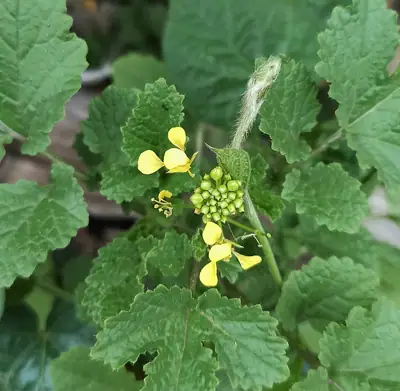
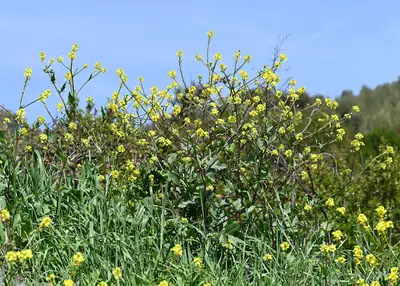


The yellow that takes over cornfields and ploughed land in spring. It is a crucifer, and no European member of this family kills, which makes it a good place to start eating wild plants.
Fields and pasture · Roadsides and waste ground · Town and roadside
Also known aswild mustard, field mustard
How to tell it
Four yellow petals in a cross. A smooth straight pod with a conical beak at the tip, without constrictions. A stem with stiff downward-pointing hairs low down. Large lobed lower leaves.
What it is confused with
Wild radish
Raphanus raphanistrum
The pod decides: mustard's is smooth, wild radish's is constricted between the seeds like a string of beads. Both edible, and the mistake costs nothing.
What it is for
Young leaves cooked and flowers in salad, as with the whole family. The seeds make a coarse mustard. Gather away from treated fields, because it is the weed that takes the most herbicide. The seeds are irritant: in quantity they cause digestive upset and are toxic to most animals, and prolonged contact with the skin raises blisters.
Traditionally used as food. This is not permission to eat it.
Where it occurs
Each square is an area with recorded observations of this plant. The lighter background is the set of areas where any of the entries has been observed, and serves as a reference. Note what this is not: it is not where the plant lives, it is where people record it, so trails and towns always look fuller than the mountains. Data from GBIF.
Sources
Community
No approved contributions for this entry yet.
Nothing appears here without a person reading it first. Contributions do not replace the entry or its warnings: until a botanist confirms, what is written above stands.