Clustered dock
Rumex conglomeratus
Family · Polygonaceae · Irritating
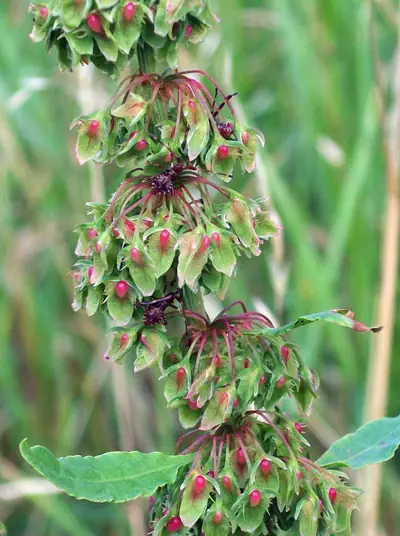
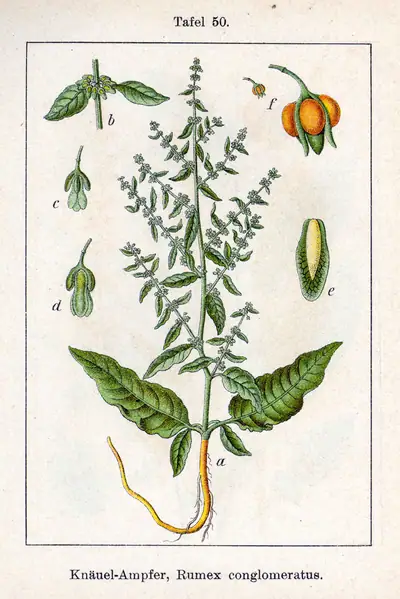


The dock of ditches and wet meadows with its fruits clustered in tight rings along leafy branches, rather than in a clean panicle like the others. It is on almost every watercourse.
Streams and ditches · Fields and pasture · Roadsides and waste ground
Also known assharp dock
How to tell it
An upright branched stem to a metre. Elongated leaves, the lower ones fiddle-shaped, narrowed in the middle. The fruits are the mark: gathered in small rings well separated along the branches, and nearly every branch has a leaf at its base. Each fruit has three elongated tubercles.
What it is confused with
Curled dock
Rumex crispus
The leaves are confused. Curled dock has strongly wavy crimped margins and fruits in dense continuous rings along the top; clustered dock has flat fiddle-shaped leaves and fruits in small well-separated rings, with a leaf at each branch base. Both were eaten cooked.
What it is for
The young leaves were eaten cooked like other docks, sour and astringent. They contain oxalic acid in amounts that bind calcium and aggravate kidney trouble: famine food, not health food. Traditional use, in the past.
Traditionally used as food. This is not permission to eat it.
Where it occurs
Each square is an area with recorded observations of this plant. The lighter background is the set of areas where any of the entries has been observed, and serves as a reference. Note what this is not: it is not where the plant lives, it is where people record it, so trails and towns always look fuller than the mountains. Data from GBIF.
Sources
Community
No approved contributions for this entry yet.
Nothing appears here without a person reading it first. Contributions do not replace the entry or its warnings: until a botanist confirms, what is written above stands.