Smooth hawksbeard
Crepis capillaris
Family · Asteraceae · Harmless
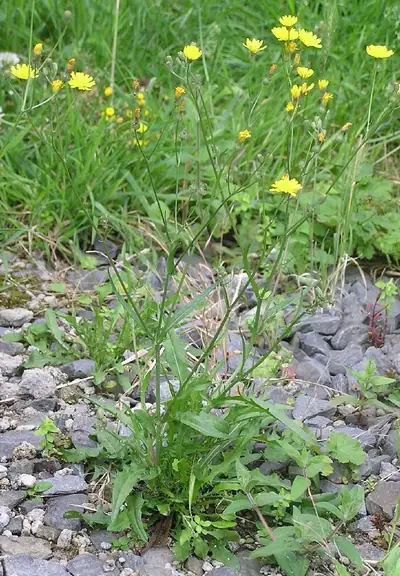
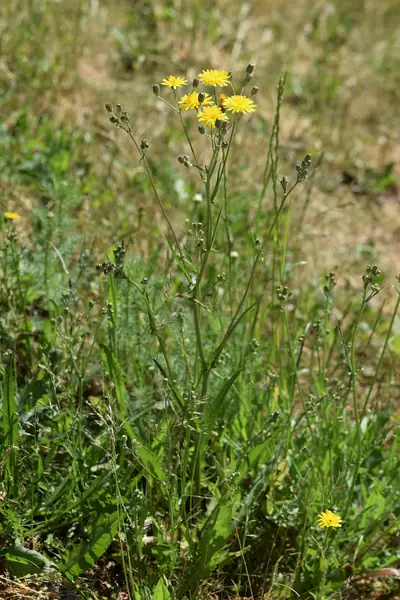


The most ordinary yellow daisy of late-summer lawns and verges, with dozens of small heads on a much branched stem and a rosette of cut leaves at the base.
Fields and pasture · Town and roadside · Roadsides and waste ground · Uplands
Also known assmooth hawk's-beard
How to tell it
Small heads, one to one and a half centimetres, many per plant. The bracts form two rows: the outer short and pressed close, the inner long, with short hairs on the back of the inner ones. Basal leaves in a rosette, cut, the lobes pointing downward. White latex.
What it is confused with
Sow thistle
Sonchus oleraceus
Sow thistle is far larger, with a thick hollow stem and leaves clasping it with two pointed ears; smooth hawksbeard is small and branched, its leaves mostly in the rosette. Both were eaten.
What it is for
The young rosette leaves were eaten in salads and cooked across Europe, bitter like chicory. Traditional use. Do not gather on road verges or on treated ground.
Traditionally used as food. This is not permission to eat it.
Where it occurs
Each square is an area with recorded observations of this plant. The lighter background is the set of areas where any of the entries has been observed, and serves as a reference. Note what this is not: it is not where the plant lives, it is where people record it, so trails and towns always look fuller than the mountains. Data from GBIF.
Sources
Community
No approved contributions for this entry yet.
Nothing appears here without a person reading it first. Contributions do not replace the entry or its warnings: until a botanist confirms, what is written above stands.