Soapwort
Saponaria officinalis
Family · Caryophyllaceae · Poisonous
Read this before the sheet
This plant, or one that resembles it, is dangerous. Identifying is not authorising: no app has the authority to tell you that you may eat or touch a plant.
Emergency
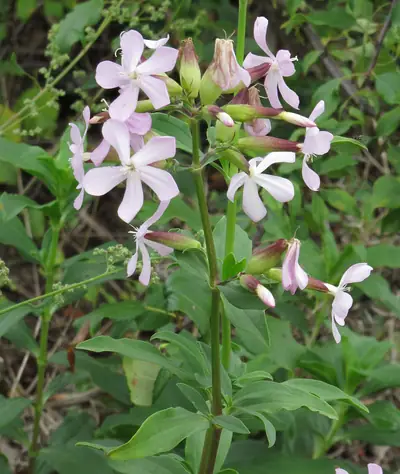


The riverbank plant with large pale pink flowers scented at dusk, whose root and leaves make real lather when rubbed in water.
Streams and ditches · Roadsides and waste ground · Town and roadside · Fields and pasture
Also known asbouncing bet, crow soap
How to tell it
An upright unbranched stem to a metre, with thick nodes. Opposite, oval to elongated leaves with three well-marked main veins running from base to tip. Pale pink or white flowers two to three centimetres, with five petals often bent back, gathered at the top. A strong scent in late afternoon.
What it is confused with
No dangerous lookalikes known in the Iberian Peninsula.
What it is for
It was soap for those who had none: the root rubbed in water lathers because of its saponins, and it is still used to clean antique textiles in museums, because it is gentle on fibre. It is not eaten: those same saponins destroy red blood cells and are toxic internally.
With documented traditional uses. Not a therapeutic indication and not a dose.
Where it occurs
Each square is an area with recorded observations of this plant. The lighter background is the set of areas where any of the entries has been observed, and serves as a reference. Note what this is not: it is not where the plant lives, it is where people record it, so trails and towns always look fuller than the mountains. Data from GBIF.
Sources
Community
No approved contributions for this entry yet.
Nothing appears here without a person reading it first. Contributions do not replace the entry or its warnings: until a botanist confirms, what is written above stands.