Rush skeletonweed
Chondrilla juncea
Family · Asteraceae · Harmless
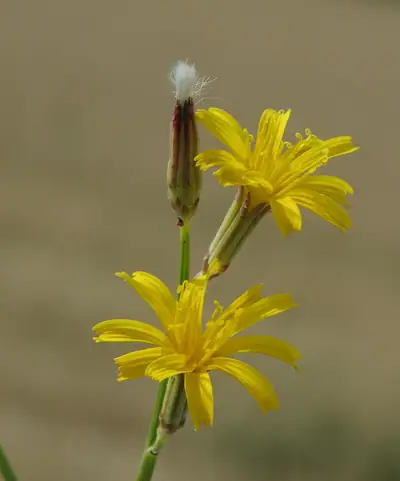
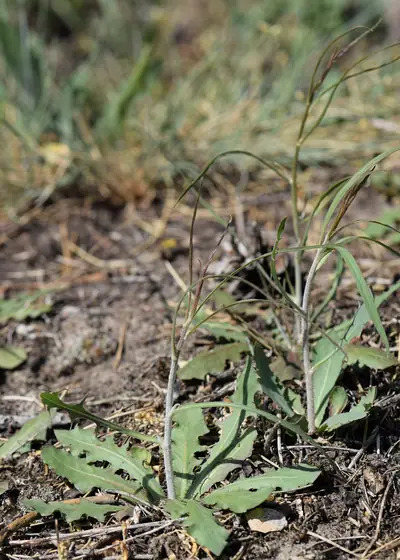


The plant that looks like a skeleton: a tangle of stiff green stems with almost no leaves, with small yellow flowers stuck here and there. In high August it is one of the few green things on a sun-scorched verge.
Roadsides and waste ground · Fields and pasture · Dunes and sand · Town and roadside
Also known asgum succory, naked weed
How to tell it
Green, stiff, much-branched stems with rough downward-pointing hairs at the base. The rosette leaves, cut like a dandelion's, dry up before flowering and vanish. Small yellow heads held against the stems. White latex.
What it is confused with
Blue aphyllanthes
Aphyllanthes monspeliensis
Both have green, nearly leafless stems. Blue aphyllanthes has six-petalled blue flowers at each stem tip; skeletonweed has yellow composite flowers along the stems, and white latex.
What it is for
The rosette leaves are eaten in salad in winter in Spain, under the name ajonjeras. The latex hardens and was chewed as gum. It is a serious cereal pest in Australia and the United States, where it was taken.
Traditionally used as food. This is not permission to eat it.
Where it occurs
Each square is an area with recorded observations of this plant. The lighter background is the set of areas where any of the entries has been observed, and serves as a reference. Note what this is not: it is not where the plant lives, it is where people record it, so trails and towns always look fuller than the mountains. Data from GBIF.
Sources
Community
No approved contributions for this entry yet.
Nothing appears here without a person reading it first. Contributions do not replace the entry or its warnings: until a botanist confirms, what is written above stands.