Nettle-leaved goosefoot
Chenopodiastrum murale
Family · Amaranthaceae · Irritating
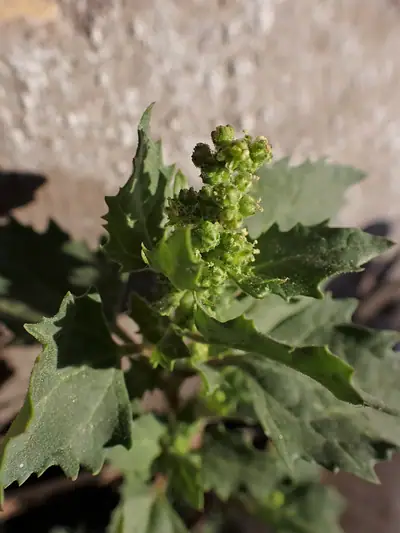
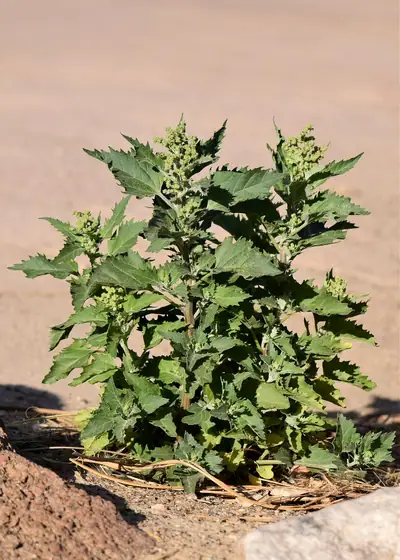


The plant of wall bases and rubble with diamond leaves bearing large sharp teeth like a nettle's, but which do not sting. It is among the plants most faithful to places where there is ammonia.
Town and roadside · Walls and rocks · Roadsides and waste ground · Fields and pasture
Also known assowbane, wall goosefoot
How to tell it
Diamond or broad triangular leaves, glossy and dark green, with large irregular forward-pointing teeth. Unlike fat hen, it has almost no white dust. Minute green flowers in loose clusters at the axils. An unpleasant smell when crushed.
What it is confused with
Stinging nettle
Urtica dioica
The leaves are alike but nettle's are opposite, in pairs, and covered in stinging hairs; goosefoot's are alternate and do not sting. They grow almost always in the same place, and the difference is felt before it is seen.
What it is for
Eaten cooked like the others in the group, but with the same brake: it accumulates nitrates and oxalates, and grows precisely where there is manure, urine and rubble. It is one of the plants you recognise and do not gather.
Traditionally used as food. This is not permission to eat it.
Where it occurs
Each square is an area with recorded observations of this plant. The lighter background is the set of areas where any of the entries has been observed, and serves as a reference. Note what this is not: it is not where the plant lives, it is where people record it, so trails and towns always look fuller than the mountains. Data from GBIF.
Sources
Community
No approved contributions for this entry yet.
Nothing appears here without a person reading it first. Contributions do not replace the entry or its warnings: until a botanist confirms, what is written above stands.