Spear thistle
Cirsium vulgare
Family · Asteraceae · Irritating
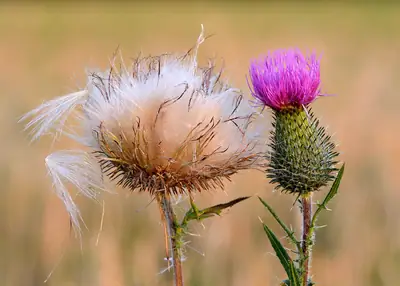
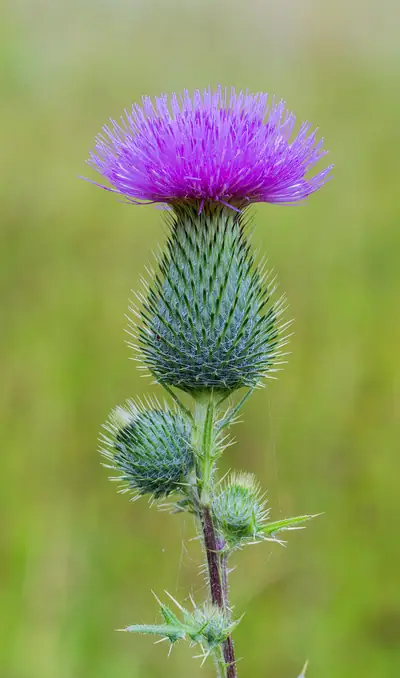


The large purple thistle of verges and abandoned fields, a crown of purple florets atop a basket of spines. It is the thistle nearly everyone pictures when they hear the word.
Roadsides and waste ground · Fields and pasture · Town and roadside · Uplands
Also known asbull thistle, common thistle
How to tell it
Up to a metre and a half, its stem winged by continuous spiny wings running down from the leaf bases. Deeply cut leaves, rough above, with a strong yellowish spine at each lobe tip. Large solitary heads, their bracts straight spines pointing outward.
What it is confused with
Cotton thistle
Onopordum acanthium
Cotton thistle is much bigger and entirely greyish white with woolly down, and its leaves are not rough to touch; spear thistle is dark green and rough above like fine sandpaper. Both merely prickle.
What it is for
The receptacle, the fleshy part beneath the flowers, was eaten in famine years across Europe, after scraping the spines and boiling it, like a poor man's artichoke. Enormous work for very little: it is history, not a recipe.
Traditionally used as food. This is not permission to eat it.
Where it occurs
Each square is an area with recorded observations of this plant. The lighter background is the set of areas where any of the entries has been observed, and serves as a reference. Note what this is not: it is not where the plant lives, it is where people record it, so trails and towns always look fuller than the mountains. Data from GBIF.
Sources
Community
No approved contributions for this entry yet.
Nothing appears here without a person reading it first. Contributions do not replace the entry or its warnings: until a botanist confirms, what is written above stands.