Creeping woodsorrel
Oxalis corniculata
Family · Oxalidaceae · Irritating
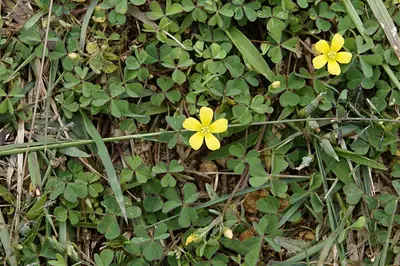
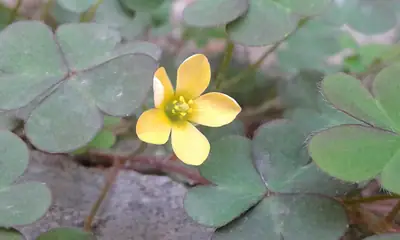


The little clover-leaved plant with a sour taste that grows in pavement joints and everyone's flowerpots, flowering all year. It is the same acidity as Bermuda buttercup, and the same warning.
Town and roadside · Walls and rocks · Fields and pasture · Roadsides and waste ground
Also known asprocumbent yellow sorrel, sleeping beauty
How to tell it
A creeping plant rooting at the nodes. Leaves of three inverted-heart leaflets, often stained wine red. Small yellow five-petalled flowers in groups of two to five. The capsules are upright cylinders that burst at a touch and shoot the seeds out.
What it is confused with
Bermuda buttercup
Oxalis pes-caprae
Bermuda buttercup is much larger, carries big flowers in an umbel atop a leafless stalk and grows from a bulb; this is small, creeping and roots at the nodes. Both hold the same oxalic acid and the same limit.
What it is for
Traditionally used as a souring agent in the smallest amounts, like the other wood sorrels. It contains oxalic acid, which in quantity binds calcium and aggravates kidney trouble: a curiosity seasoning, never a salad.
Traditionally used as food. This is not permission to eat it.
Where it occurs
Each square is an area with recorded observations of this plant. The lighter background is the set of areas where any of the entries has been observed, and serves as a reference. Note what this is not: it is not where the plant lives, it is where people record it, so trails and towns always look fuller than the mountains. Data from GBIF.
Sources
Community
No approved contributions for this entry yet.
Nothing appears here without a person reading it first. Contributions do not replace the entry or its warnings: until a botanist confirms, what is written above stands.