Borage
Borago officinalis
Family · Boraginaceae · Irritating
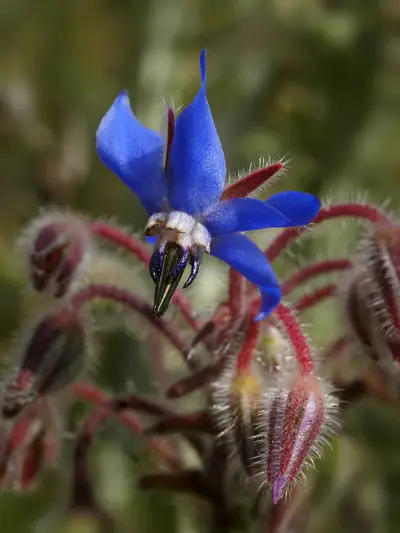
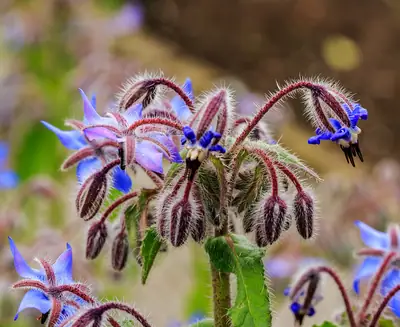


The blue star flower, hanging downwards, on a rough plant covered in bristles. In Aragón it is a market vegetable; in Portugal it is a verge weed almost nobody uses.
Roadsides and waste ground · Fields and pasture · Town and roadside
Also known asstarflower
How to tell it
The whole plant is covered in stiff bristles that prickle lightly. Blue five-pointed flowers with a black centre, facing the ground. Large wrinkled leaves that taste of cucumber.
What it is confused with
Purple viper's bugloss
Echium plantagineum
Both are blue and hairy. Purple viper's bugloss has funnel flowers along a curved stem, not downward-facing stars, and far more alkaloids. It is not eaten.
What it is for
Stems and leaves cooked as a vegetable in the Ebro valley, and the flowers used to decorate and in drinks. A note that belongs on the sheet: the borage family contains pyrrolizidine alkaloids, liver-toxic with sustained intake, so it is an occasional dish and not a staple.
Traditionally used as food. This is not permission to eat it.
With documented traditional uses. Not a therapeutic indication and not a dose.
Where it occurs
Each square is an area with recorded observations of this plant. The lighter background is the set of areas where any of the entries has been observed, and serves as a reference. Note what this is not: it is not where the plant lives, it is where people record it, so trails and towns always look fuller than the mountains. Data from GBIF.
Sources
Community
No approved contributions for this entry yet.
Nothing appears here without a person reading it first. Contributions do not replace the entry or its warnings: until a botanist confirms, what is written above stands.