Dragon arum
Dracunculus vulgaris
Family · Araceae · Poisonous
Read this before the sheet
This plant, or one that resembles it, is dangerous. Identifying is not authorising: no app has the authority to tell you that you may eat or touch a plant.
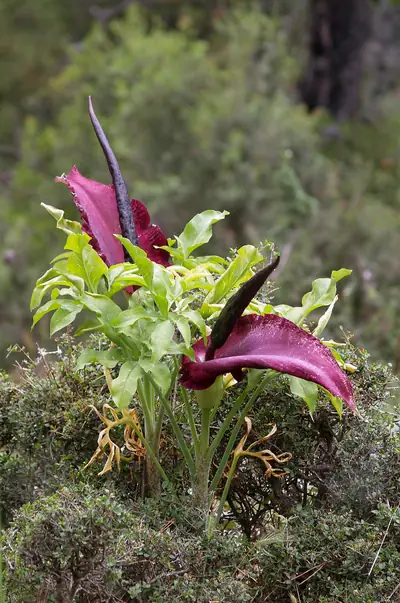
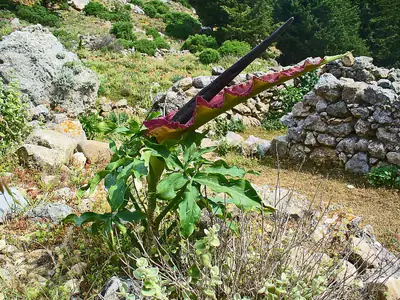


The plant nobody forgets after smelling it: a forty-centimetre purple spathe with a black spadix down the middle, which for one day smells of rotting meat to attract flies. All of it is toxic and the sap irritates skin and mouth.
Walls and rocks · Roadsides and waste ground · Oak woods · Town and roadside
Also known asdragon lily, voodoo lily, stink lily
How to tell it
Half a metre to a metre. The stem is green with irregular dark blotches, like snakeskin, hence the name. The leaves are large and divided into fan-spread segments. The inflorescence cannot be confused: a broad spathe, dark purple inside, wrapping a straight black spadix that projects out. It stinks for a day and then stops. At the end of summer, orange-red berries remain packed in a spike.
What it is confused with
Italian arum
Arum italicum
Italian arum has a whitish or pale green spathe and a yellow spadix, arrow-shaped leaves with pale veins, and no stench. Dragon arum has a dark purple spathe, a black spadix and a mottled stem. Both are toxic and neither goes near the mouth.
What it is for
No use to recommend. It was a plant of superstition and curiosity gardens. The sap holds calcium oxalate crystals that burn and swell the mouth, and the berries are toxic and attractive to children. Do not handle without gloves and do not take it home.
Where it occurs
Each square is an area with recorded observations of this plant. The lighter background is the set of areas where any of the entries has been observed, and serves as a reference. Note what this is not: it is not where the plant lives, it is where people record it, so trails and towns always look fuller than the mountains. Data from GBIF.