Hottentot fig
Carpobrotus edulis
Family · Aizoaceae · Harmless
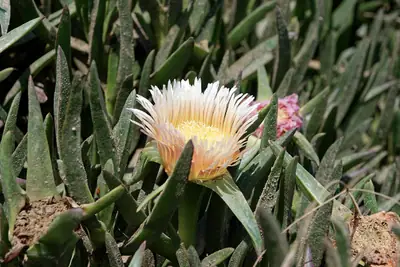
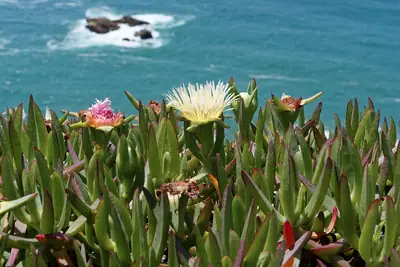


The succulent carpet of yellow and purple flowers covering cliffs and dunes from north to south, which almost everyone finds beautiful. It is South African and among the worst invaders of the Iberian coast.
Dunes and sand · Walls and rocks · Town and roadside
Also known asice plant, sour fig
How to tell it
Thick three-sided leaves like green knives, on creeping stems metres long. Large showy flowers, yellow or magenta, opening only in sun.
What it is confused with
Sally-my-handsome
Carpobrotus acinaciformis
Two closely related invaders that hybridise. Acinaciformis has a large magenta flower and a more curved leaf; edulis has a yellow flower that ages pink. For practical purposes both are removed.
What it is for
The fruit is edible and used for jam in South Africa, but that is no reason to keep it here: it acidifies the sand, smothers native dune flora and breaks down the dune's structure.
Traditionally used as food. This is not permission to eat it.
The law says
An invasive alien species in Portugal. Do not plant or propagate it, and dune removal actions are done with authorisation and method.
Where it occurs
Each square is an area with recorded observations of this plant. The lighter background is the set of areas where any of the entries has been observed, and serves as a reference. Note what this is not: it is not where the plant lives, it is where people record it, so trails and towns always look fuller than the mountains. Data from GBIF.
Sources
Community
No approved contributions for this entry yet.
Nothing appears here without a person reading it first. Contributions do not replace the entry or its warnings: until a botanist confirms, what is written above stands.