Portuguese crowberry
Corema album
Family · Ericaceae · Harmless
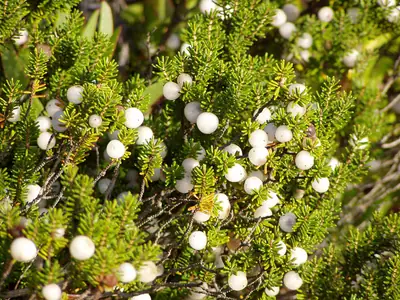
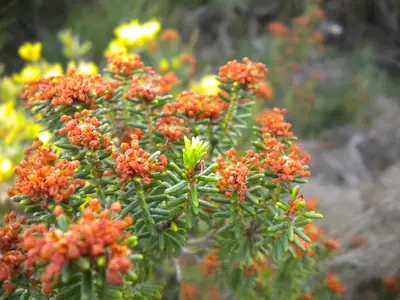


The low dune shrub of the Atlantic coast that bears edible white berries in August. It is almost exclusive to the Iberian coast and is in retreat across its whole range.
Dunes and sand
Also known aswhite crowberry
How to tell it
A dense low cushion of short, tightly packed dark green needle leaves. White or pinkish berries the size of a chickpea, grouped at the tips. Only on coastal sand.
What it is confused with
Phoenicean juniper
Juniperus turbinata
They share the dune and the low habit. Phoenicean juniper has scale leaves pressed to the twig and reddish-brown cones; crowberry has loose needles and white berries. The white berries are the mark.
What it is for
The berries are eaten raw, sour and refreshing, and were for centuries a snack for people working the coast. Today they are picked sparingly, because the plant is in decline.
Traditionally used as food. This is not permission to eat it.
The law says
A declining species, protected in several classified dune systems. Do not uproot the plant and do not gather inside protected areas.
Where it occurs
Each square is an area with recorded observations of this plant. The lighter background is the set of areas where any of the entries has been observed, and serves as a reference. Note what this is not: it is not where the plant lives, it is where people record it, so trails and towns always look fuller than the mountains. Data from GBIF.
Sources
Community
No approved contributions for this entry yet.
Nothing appears here without a person reading it first. Contributions do not replace the entry or its warnings: until a botanist confirms, what is written above stands.