Comfrey
Symphytum officinale
Family · Boraginaceae · Poisonous
Read this before the sheet
This plant, or one that resembles it, is dangerous. Identifying is not authorising: no app has the authority to tell you that you may eat or touch a plant.
Emergency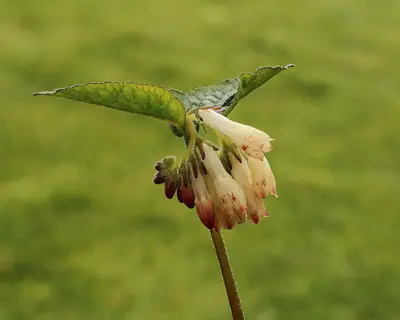
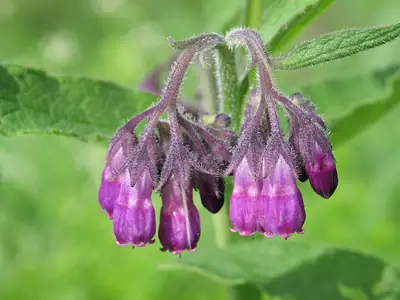


The large rough plant of damp margins, with bell flowers hanging from one side of a curved stem. It is here mostly for one reason: it is foxglove's double before flowering, and that confusion has killed.
Streams and ditches · Fields and pasture · Roadsides and waste ground
Also known asknitbone, boneset
How to tell it
The whole plant is covered in stiff bristles that prickle lightly. Large lance-shaped leaves running down the stem as wings, which foxglove does not do. Bell flowers, purple, pink or white, on a stem coiled like a scorpion's tail.
What it is confused with
Foxglove
Digitalis purpurea
Before flowering they are very alike, and that is when the mistake happens. Comfrey's leaf runs down the stem as two wings, and the plant is rough with stiff bristles; foxglove's grows in a rosette, is velvet-soft and does not run down the stem. Without a flower, gather neither.
What it is for
Traditional external use on sprains and fractures across Europe, hence the names suelda and knitbone. Important note: it contains hepatotoxic pyrrolizidine alkaloids, and internal use is discouraged and banned in several countries. Comfrey tea is not made.
With documented traditional uses. Not a therapeutic indication and not a dose.
Where it occurs
Each square is an area with recorded observations of this plant. The lighter background is the set of areas where any of the entries has been observed, and serves as a reference. Note what this is not: it is not where the plant lives, it is where people record it, so trails and towns always look fuller than the mountains. Data from GBIF.
Sources
Community
No approved contributions for this entry yet.
Nothing appears here without a person reading it first. Contributions do not replace the entry or its warnings: until a botanist confirms, what is written above stands.