Common field speedwell
Veronica persica
Family · Plantaginaceae · Harmless
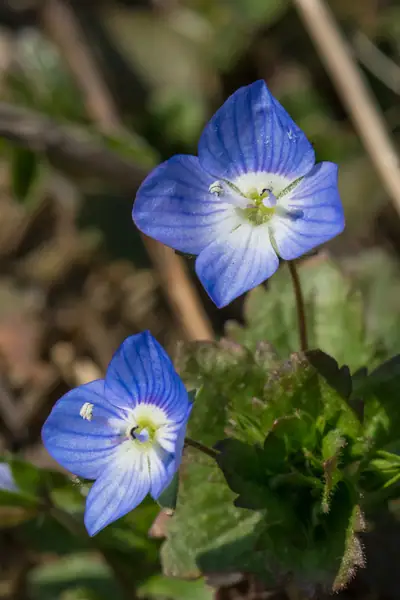
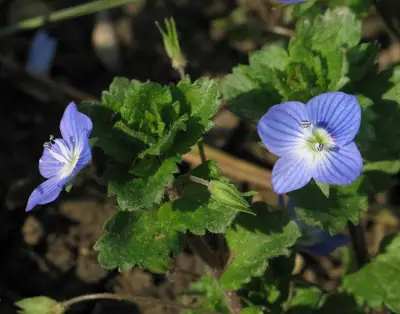


The pale blue four-petalled flower, its lowest petal paler and dark stripes pointing to the centre, appearing in gardens and beds even in midwinter. It came from Asia in the nineteenth century and stayed.
Town and roadside · Fields and pasture · Roadsides and waste ground
Also known asbird's-eye speedwell, Persian speedwell
How to tell it
A prostrate hairy plant. Blue flowers of four unequal petals, always solitary on a long stalk rising from the axil of an ordinary leaf, which separates it from the spiked speedwells. The fruit is a flat capsule with two widely spread lobes, like two cheeks.
What it is confused with
Wall speedwell
Veronica arvensis
Wall speedwell has tiny flowers, two to three millimetres, half hidden among leaves at the stem tip; the Persian has large flowers, eight to twelve millimetres, each on a long stalk and well in view.
What it is for
No use
It is one of the world's most widespread garden weeds and serves as the opposite warning: a pretty, harmless plant can be exotic and taking the place of natives.
Where it occurs
Each square is an area with recorded observations of this plant. The lighter background is the set of areas where any of the entries has been observed, and serves as a reference. Note what this is not: it is not where the plant lives, it is where people record it, so trails and towns always look fuller than the mountains. Data from GBIF.
Sources
Community
No approved contributions for this entry yet.
Nothing appears here without a person reading it first. Contributions do not replace the entry or its warnings: until a botanist confirms, what is written above stands.