Flax-leaved daphne
Daphne gnidium
Family · Thymelaeaceae · Can kill
Read this before the sheet
This plant, or one that resembles it, is dangerous. Identifying is not authorising: no app has the authority to tell you that you may eat or touch a plant.
Emergency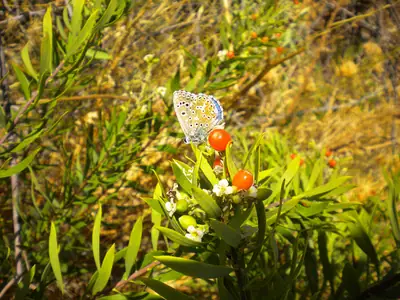
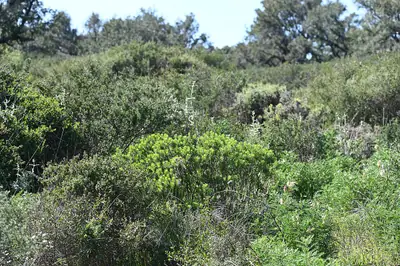


The upright, unremarkable shrub of Mediterranean scrub, with narrow leaves packed along the stem and red berries in autumn. The bark does not snap: it bends and strips like cord.
Scrubland · Pine woods · Dunes and sand · Montado
Also known asMediterranean mezereon
How to tell it
Try to snap a twig: it will not break, it bends and the bark peels off in fibrous strips. Narrow stiff leaves, green all year, packed in a spiral. Red or orange berries.
What it is confused with
No dangerous lookalikes known in the Iberian Peninsula.
What it is for
None acceptable today
It was traditionally used to stun fish in river pools, a long-banned practice, and the bark served as cord. Prolonged contact with the sap burns the skin.
Where it occurs
Each square is an area with recorded observations of this plant. The lighter background is the set of areas where any of the entries has been observed, and serves as a reference. Note what this is not: it is not where the plant lives, it is where people record it, so trails and towns always look fuller than the mountains. Data from GBIF.
Sources
Community
No approved contributions for this entry yet.
Nothing appears here without a person reading it first. Contributions do not replace the entry or its warnings: until a botanist confirms, what is written above stands.