Meadow saxifrage
Saxifraga granulata
Family · Saxifragaceae · Harmless
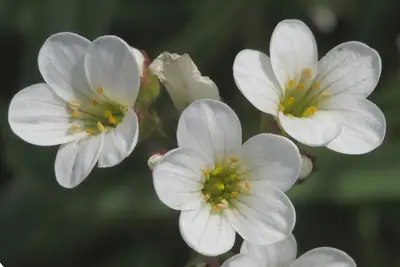
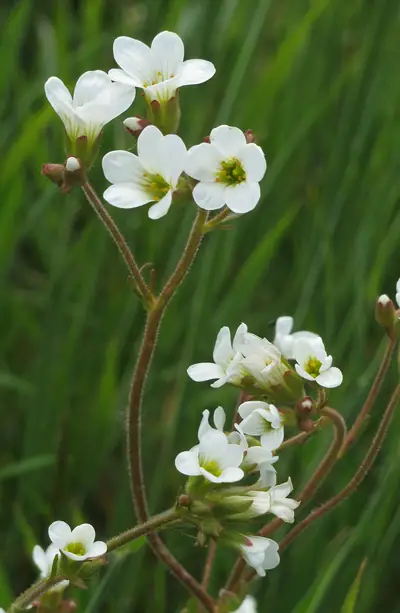


The white five-petalled flowers dotting mountain meadows and banks in spring, above a rosette of kidney-shaped leaves. Below ground there are grain-like bulbils, which give the name.
Uplands · Fields and pasture · Walls and rocks · Oak woods
Also known asfair maids of France, bulbous saxifrage
How to tell it
A basal rosette of kidney or fan-shaped leaves, the edge cut into rounded lobes, on a long stalk. A hairy glandular flowering stem with few leaves. White five-petalled flowers one to two centimetres, with fine visible veins. The stem base carries small red bulbils, like wheat grains.
What it is confused with
No dangerous lookalikes known in the Iberian Peninsula.
What it is for
Traditional medicinal use for kidney stones, which is where the scientific name and all the folk names come from: a plant that breaks rock was thought to break kidney stones. Traditional use, in the past, and the logic was the doctrine of signatures, not pharmacology.
With documented traditional uses. Not a therapeutic indication and not a dose.
Where it occurs
Each square is an area with recorded observations of this plant. The lighter background is the set of areas where any of the entries has been observed, and serves as a reference. Note what this is not: it is not where the plant lives, it is where people record it, so trails and towns always look fuller than the mountains. Data from GBIF.
Sources
Community
No approved contributions for this entry yet.
Nothing appears here without a person reading it first. Contributions do not replace the entry or its warnings: until a botanist confirms, what is written above stands.