Japanese cheesewood
Pittosporum tobira
Family · Pittosporaceae · Irritating
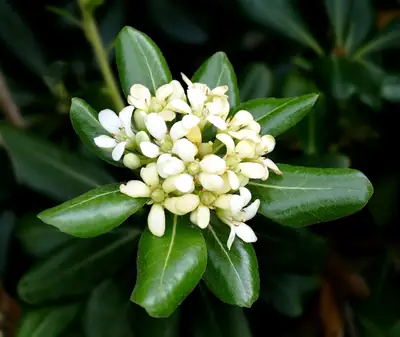
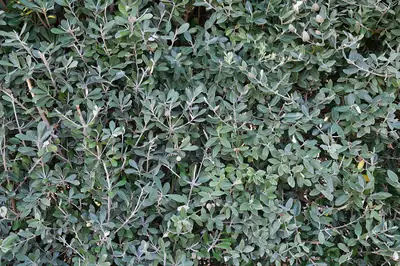


The garden hedge that in May fills whole streets with the scent of orange blossom. It came from Japan, escaped into coastal dunes and cliffs, and today competes with native coastal vegetation.
Town and roadside · Dunes and sand · Walls and rocks · Roadsides and waste ground
Also known asmock orange, Australian laurel
How to tell it
Leathery spoon-shaped leaves clustered in a rosette at branch tips, dark green and very glossy, with down-rolled margins. White flowers ageing yellow, sweetly and strongly scented. Capsules splitting in three to show sticky red seeds.
What it is confused with
No dangerous lookalikes known in the Iberian Peninsula.
What it is for
Ornamental and windbreak hedge, widely planted on the coast for its salt tolerance. The seeds are toxic and the resin irritates sensitive skin. Not a plant to propagate.
The law says
An invasive alien species in Portugal, with documented impact on dune systems. Do not plant or propagate it.
Where it occurs
Each square is an area with recorded observations of this plant. The lighter background is the set of areas where any of the entries has been observed, and serves as a reference. Note what this is not: it is not where the plant lives, it is where people record it, so trails and towns always look fuller than the mountains. Data from GBIF.
Sources
Community
No approved contributions for this entry yet.
Nothing appears here without a person reading it first. Contributions do not replace the entry or its warnings: until a botanist confirms, what is written above stands.