Pampas grass
Cortaderia selloana
Family · Poaceae · Irritating
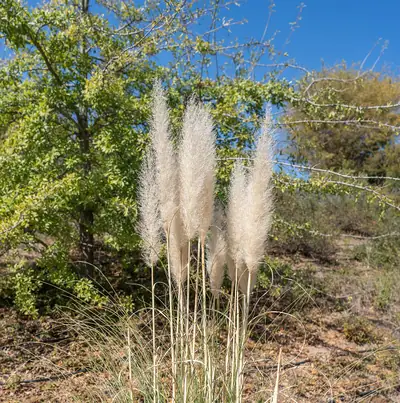
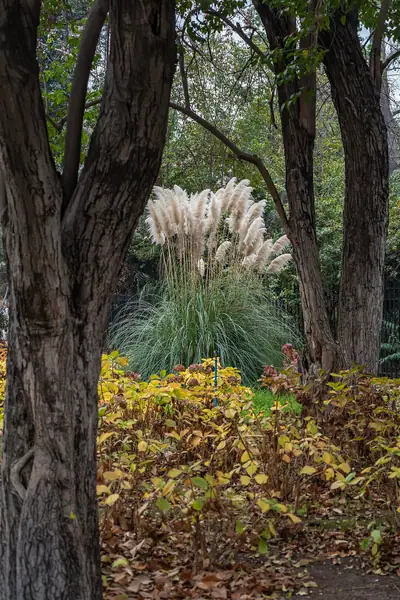


The huge tussock of long leaves topped by silky white plumes two or three metres up, which has taken over roadsides, embankments and coastal sands. It is invasive in Portugal and Spain, and each plume releases hundreds of thousands of wind-borne seeds.
Roadsides and waste ground · Fields and pasture · Town and roadside · Dunes and sand · Streams and ditches
Also known aspampas grass, silver pampas grass
How to tell it
A dense tussock one to three metres across, with two-metre leaves, narrow, arching and bluish green. The flowering stems rise well above the leaves and end in a dense plume twenty to seventy centimetres long, silvery white or pinkish. Mind the leaves: the margin carries microscopic teeth and cuts skin like a blade when a hand is drawn along it. That is what gives it the name cutting grass.
What it is confused with
Giant reed
Arundo donax
Giant reed has a woody hollow cane like bamboo, with leaves along it, and a looser brownish panicle. Pampas grass is a tussock of leaves from the ground, with the white plume high above. Both are invasive.
Open sheet →What it is for
No use. It was planted as an ornamental and is now a conservation problem: it takes over dunes and abandoned ground, displaces native vegetation and is very hard to eradicate. Cutting the plumes before they shed seed is the one measure within anyone's reach.
The law says
It is on the Portuguese national list of invasive species (Decree-Law 92/2019). Planting, growing, selling or transporting it is prohibited in Portugal.
Where it occurs
Each square is an area with recorded observations of this plant. The lighter background is the set of areas where any of the entries has been observed, and serves as a reference. Note what this is not: it is not where the plant lives, it is where people record it, so trails and towns always look fuller than the mountains. Data from GBIF.