Yellow bee orchid
Ophrys lutea
Family · Orchidaceae · Harmless
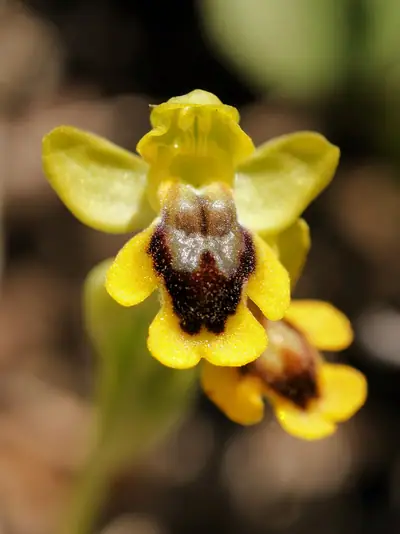
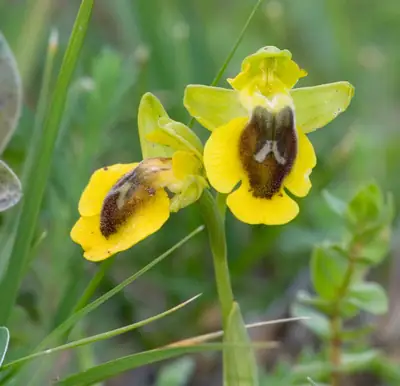


The easiest of our bee orchids to recognise: a dark brown lip in the centre with a broad bright yellow margin all round, like a seal. It flowers early, on limestone and open southern scrub.
Scrubland · Fields and pasture · Pine woods · Uplands
Also known asyellow ophrys
How to tell it
A short spike of two to six flowers. The sepals are green and spreading. The lip is the signature: three lobes, the central one with a dark brown or bluish blotch in the middle and a broad bright yellow rim, folded down at the edges. A rosette of pale green basal leaves.
What it is confused with
Dark bee orchid
Ophrys fusca
Both have a brown lip and grow together. The yellow one has a broad obvious yellow rim all round the lip; the dark one is brown right to the edge, with no yellow rim or only a very thin line.
What it is for
None
Like all orchids of the genus, it deceives male bees, which try to mate with the flower and pollinate it in the process. An orchid is not picked, not transplanted and does not survive away from where it grew, because it depends on soil fungi.
The law says
Protected by CITES and national law, like all wild orchids. Photograph it, do not pick it.
Where it occurs
Each square is an area with recorded observations of this plant. The lighter background is the set of areas where any of the entries has been observed, and serves as a reference. Note what this is not: it is not where the plant lives, it is where people record it, so trails and towns always look fuller than the mountains. Data from GBIF.
Sources
Community
No approved contributions for this entry yet.
Nothing appears here without a person reading it first. Contributions do not replace the entry or its warnings: until a botanist confirms, what is written above stands.