Sun spurge
Euphorbia helioscopia
Family · Euphorbiaceae · Poisonous
Read this before the sheet
This plant, or one that resembles it, is dangerous. Identifying is not authorising: no app has the authority to tell you that you may eat or touch a plant.
Emergency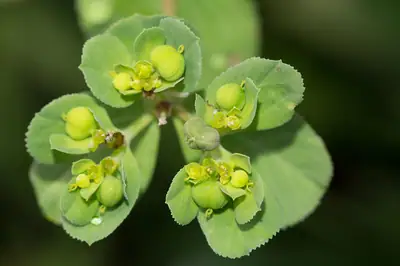
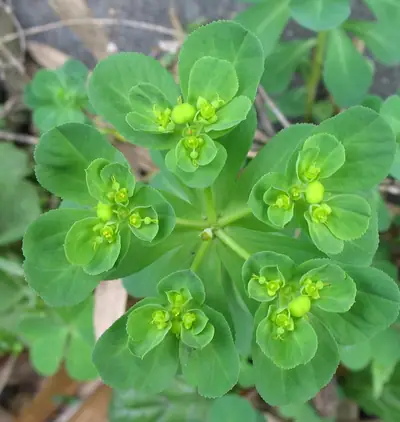


The commonest spurge of gardens and pots, pale green and harmless-looking, with an inflorescence opening in five rays that turn towards the sun. Break a stem and the problem becomes clear.
Town and roadside · Fields and pasture · Roadsides and waste ground
Also known asmadwoman's milk, wartweed
How to tell it
Immediate white latex from any cut. Spoon-shaped leaves, finely toothed at the tip, pale green and hairless. At the top, five rays dividing again, with yellow-green bracts that look like petals.
What it is confused with
Petty spurge
Euphorbia peplus
They live in the same pot and are equally toxic, so the distinction is curiosity rather than safety. Sun spurge has leaves toothed at the tip and five rays; petty spurge has smooth-edged leaves and three rays.
What it is for
None
It was used on warts for its caustic latex, like celandine, and it is precisely because it is caustic that it is not used: it burns healthy skin just as effectively. Swallowed, it causes severe inflammation of the mouth and gut.
Where it occurs
Each square is an area with recorded observations of this plant. The lighter background is the set of areas where any of the entries has been observed, and serves as a reference. Note what this is not: it is not where the plant lives, it is where people record it, so trails and towns always look fuller than the mountains. Data from GBIF.
Sources
Community
No approved contributions for this entry yet.
Nothing appears here without a person reading it first. Contributions do not replace the entry or its warnings: until a botanist confirms, what is written above stands.