Marram grass
Ammophila arenaria
Family · Poaceae · Harmless
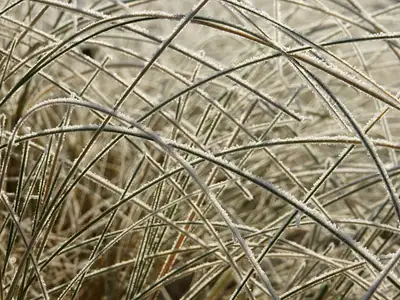
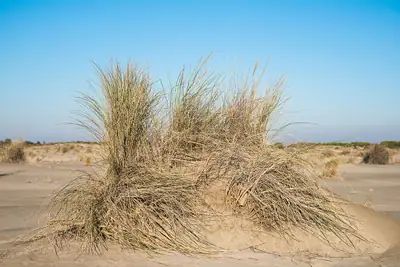


The tall rough grass that holds the dunes along the whole Portuguese coast. Without it the dune walks, which is why the boardwalks exist: every footstep kills a tuft that took years to establish.
Dunes and sand
Also known asEuropean beachgrass
How to tell it
Stiff tufts of blue-grey leaves rolled inwards like tubes, prickly to the hand. A dense pale spike in summer. It grows buried to the neck in loose sand.
What it is confused with
No dangerous lookalikes known in the Iberian Peninsula.
What it is for
It was deliberately planted along the whole coast to fix sand, since the 19th century. Today its use is ecological: each tuft traps sand and builds dune.
The law says
The primary dune is protected along almost the whole coast. Do not walk off the boardwalks, do not gather, and do not set anything up on top of it.
Where it occurs
Each square is an area with recorded observations of this plant. The lighter background is the set of areas where any of the entries has been observed, and serves as a reference. Note what this is not: it is not where the plant lives, it is where people record it, so trails and towns always look fuller than the mountains. Data from GBIF.
Sources
Community
No approved contributions for this entry yet.
Nothing appears here without a person reading it first. Contributions do not replace the entry or its warnings: until a botanist confirms, what is written above stands.