Ivy-leaved toadflax
Cymbalaria muralis
Family · Plantaginaceae · Harmless
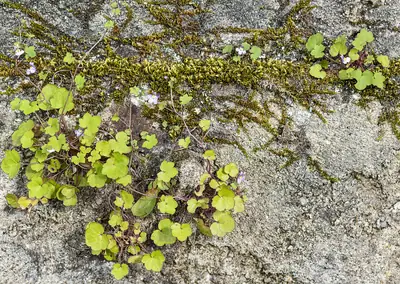
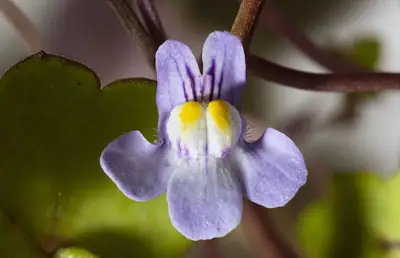


The climber with miniature ivy leaves and tiny lilac flowers that covers old walls, stairways and ruins. It has one of the most ingenious behaviours in botany: after flowering, the flower stalk turns away from the light.
Walls and rocks · Town and roadside · Streams and ditches
Also known asKenilworth ivy, wandering sailor
How to tell it
Small rounded leaves with five to seven lobes, like a miniature ivy, often purplish beneath. Lilac flowers with a short spur and two yellow spots at the throat, like a tiny snapdragon. Thin red stems hanging from the wall.
What it is confused with
Navelwort
Umbilicus rupestris
They share the wall and both are edible. Navelwort has a fleshy disc leaf with a dimple in the middle; ivy-leaved toadflax has a thin lobed leaf like ivy.
What it is for
The leaves are eaten in salad, with a peppery cress taste, a little-known but old use. What really pays is the observation: while flowering, the stalk turns towards the light to attract insects; once fertilised, it turns the other way and pushes the capsule into the wall's crack, where the seed germinates. The plant sows itself.
Traditionally used as food. This is not permission to eat it.
Where it occurs
Each square is an area with recorded observations of this plant. The lighter background is the set of areas where any of the entries has been observed, and serves as a reference. Note what this is not: it is not where the plant lives, it is where people record it, so trails and towns always look fuller than the mountains. Data from GBIF.
Sources
Community
No approved contributions for this entry yet.
Nothing appears here without a person reading it first. Contributions do not replace the entry or its warnings: until a botanist confirms, what is written above stands.