Maltese star thistle
Centaurea melitensis
Family · Asteraceae · Irritating
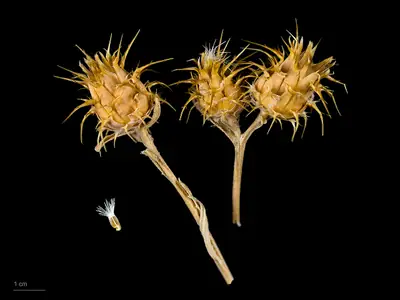
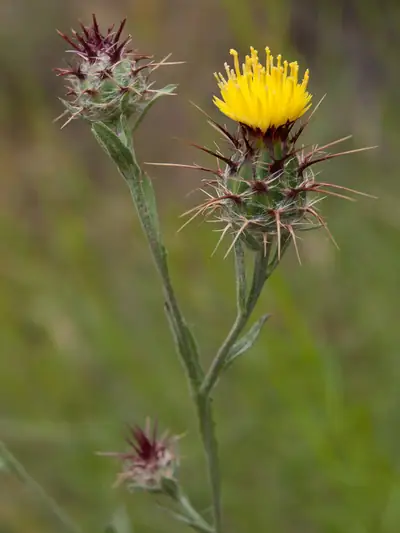


The yellow knapweed of dry fields and fallow land, with small heads armed with straight spines in a star. It covers abandoned ground all over the south at the end of spring.
Fields and pasture · Roadsides and waste ground · Town and roadside · Scrubland
Also known asMaltese centaury, tocalote
How to tell it
An upright plant with a stem winged by continuous green wings running down from the leaves. Small heads, a centimetre across, with yellow florets. The bracts end in a central spine five to ten millimetres, with two or three pairs of smaller spines at its base, forming a star.
What it is confused with
Purple star thistle
Centaurea calcitrapa
Colour decides: yellow on Maltese star thistle, purple on the star thistle. And the star thistle has far larger spines, two to three centimetres, and a wingless stem.
What it is for
No use
It is an aggressive invader in California and Australia, where it travelled in cereal seed, and is a clear indicator of degraded pasture.
Where it occurs
Each square is an area with recorded observations of this plant. The lighter background is the set of areas where any of the entries has been observed, and serves as a reference. Note what this is not: it is not where the plant lives, it is where people record it, so trails and towns always look fuller than the mountains. Data from GBIF.
Sources
Community
No approved contributions for this entry yet.
Nothing appears here without a person reading it first. Contributions do not replace the entry or its warnings: until a botanist confirms, what is written above stands.