Thatching grass
Hyparrhenia hirta
Family · Poaceae · Harmless
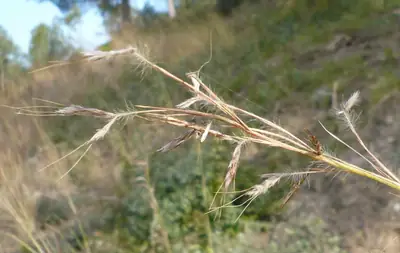
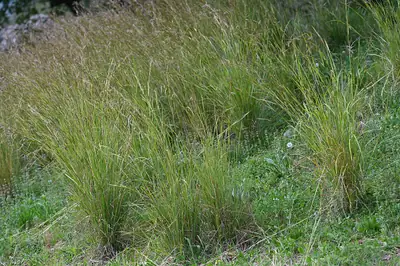


The grass that turns dry slopes and limestone banks golden at the end of summer, in hard tussocks with paired hairy spikelets and twisted awns like beard hairs. Where it grows, there was fire or grazing.
Scrubland · Roadsides and waste ground · Uplands · Walls and rocks
Also known ascommon thatching grass, coolatai grass
How to tell it
A dense tussock thirty to ninety centimetres, with narrow, rough, inrolled leaves. At the top of each stem sit paired small spikes, set against each other and wrapped in a sheath, full of white hairs and with bent twisted brown awns. Dry, it turns pale straw and stands all winter.
What it is confused with
No dangerous lookalikes known in the Iberian Peninsula.
What it is for
It was used to thatch roofs and sheds and to make rough brooms. As pasture it is poor, and livestock eat it only when young. No human food use.
Where it occurs
Each square is an area with recorded observations of this plant. The lighter background is the set of areas where any of the entries has been observed, and serves as a reference. Note what this is not: it is not where the plant lives, it is where people record it, so trails and towns always look fuller than the mountains. Data from GBIF.