Thick-leaved stonecrop
Sedum dasyphyllum
Family · Crassulaceae · Harmless
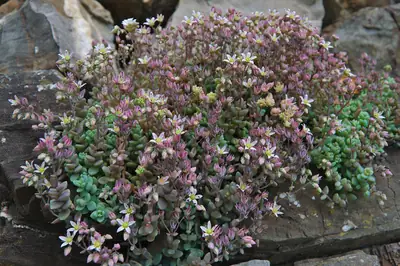
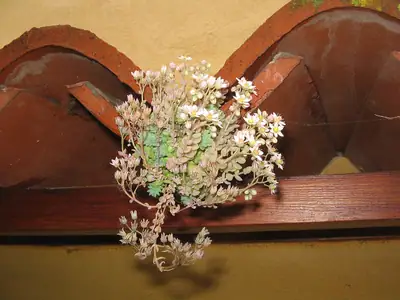


The mat of fleshy blue-grey beads covering wall tops and rock cracks, so smooth it looks made of beads. It flowers white with pink stripes.
Walls and rocks · Uplands · Town and roadside
Also known asCorsican stonecrop, blue stonecrop
How to tell it
Small, nearly spherical fleshy leaves, blue-grey or purplish, in opposite pairs packed tight on the sterile shoots. Covered in microscopic glandular hairs giving a dull, slightly sticky look. White five-petalled flowers with a pink stripe down the middle. Range: mainly a Spanish plant, practically absent from Portugal.
What it is confused with
White stonecrop
Sedum album
The leaves decide: sausage-shaped and green or reddish on white stonecrop, nearly spherical and blue-grey on this. And this one's come in pairs, white stonecrop's alternate. Neither is dangerous.
What it is for
No use
It serves to explain these plants' metabolism: they open their pores only at night, so as not to lose water in the sun, and that is why they survive on a roof tile.
Where it occurs
Each square is an area with recorded observations of this plant. The lighter background is the set of areas where any of the entries has been observed, and serves as a reference. Note what this is not: it is not where the plant lives, it is where people record it, so trails and towns always look fuller than the mountains. Data from GBIF.
Sources
Community
No approved contributions for this entry yet.
Nothing appears here without a person reading it first. Contributions do not replace the entry or its warnings: until a botanist confirms, what is written above stands.